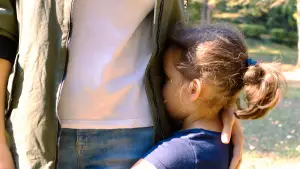

Sunday evening is its own kind of dread. Your child goes quiet at dinner. The stomach ache appears out of nowhere. By bedtime they’re asking if they have to go tomorrow, and you can hear in their voice that they already know the answer is yes, and that something about that answer is breaking them.
Monday morning confirms it. Tears before breakfast. A body that won’t move. A child standing frozen at the school gate who genuinely cannot explain why, who says they want to go, who is just as confused as you are.
You’ve tried firmness. You’ve tried gentle. You’ve tried rewards, consequences, early bedtimes, talking it through the night before. Nothing sticks.
Here’s what’s worth knowing before anything else: the term “school refusal” is actually being replaced in Australian research. Researchers, and the 2023 Federal Senate Inquiry into this exact issue, are moving toward calling it “school can’t” because “refusal” implies a choice. For most children in this situation, it isn’t a choice. That matters, because everything about how you help your child depends on understanding what’s actually happening in their brain.
School refusal in Australia has become significant enough that the Federal Government held a Senate Inquiry into it in 2023.
It’s not defiance. Here’s what it actually is.
When your child’s nervous system registers school as threatening, whether that’s because of social anxiety, sensory overwhelm, fear of failure, separation worry, or the sheer relentless demand of a school day, the brain’s threat detector fires.
Think of it like a smoke alarm. A sensitive one. It doesn’t check whether the threat is real. It just responds. And when it fires, the body follows: stomach cramps, headaches, racing heart, nausea. These aren’t manufactured for your benefit. They are genuine physiological responses to what the brain has classified as danger. Your child is not lying about the stomach ache. Their body is producing it.
Here’s the part that surprises most parents.
Every time your child stays home and the distress passes, the brain logs that as confirmation: avoidance worked. School was dangerous, and we escaped it. The relief your child feels by 10am on a home day isn’t just comfort. It’s the brain filing away new evidence that the alarm was right to fire. Next time, it fires sooner. And louder. And the idea of return becomes its own source of dread.
As one parent described: “She had a bad week, so I kept her home for two weeks to let her settle. By the end of it, she couldn’t even look at her school bag.” That’s not a parenting failure. That’s the anxiety cycle doing exactly what it does.
Keeping your child home feels like compassion. Neurologically, it teaches the brain to be more afraid. This doesn’t mean you force a distressed child out the door with no support. It means the goal of getting them back can’t wait, because time works against you here.
For children with ADHD, autism, or sensory differences, the alarm system is often running hotter to begin with. A school day involves noise, unpredictability, social demands, fluorescent lights, transitions, and the constant effort of appearing regulated when you’re not. For some kids, the nervous system is in partial shutdown before they’ve even reached the classroom. The mechanism is the same. The intensity is different.
What actually helps
The research on school refusal is clear on one thing: waiting for it to resolve rarely works. The anxiety cycle deepens, social connections erode, and the idea of return becomes its own mountain. In 2024, nearly 483,000 Australian students missed more than 10% of their school days. A 2024 survey found 39% of Australian families had experienced a child unable to attend school because of anxiety or stress. This isn’t rare. And it doesn’t usually improve without a plan.
Here’s what the evidence supports.
1. Name what’s happening, without blame
Before anything practical, your child needs to hear that what’s happening to them makes sense. Not that it’s okay to stay home. That it makes sense. There’s a difference.
Something like: “I know school feels really unsafe right now. That’s real, and we’re going to work on it together.” That script does a specific thing: it validates the distress without validating the avoidance. It also keeps you regulated, and a calm, steady parent nervous system genuinely helps regulate a dysregulated child. Not by magic. By biology. We co-regulate. Their nervous system takes cues from yours.
What doesn’t help on a school morning: negotiating. Asking why. Revisiting the argument you had on Sunday. Monday mornings should be low-stimulation and predictable, same routine, minimal talking about school. Save the deeper conversations for calm times. Distress is not the window for problem-solving.
2. Don’t accidentally reward staying home
If your child does stay home, and sometimes that’s unavoidable, the environment matters. Low stimulation. No screens, no special activities, no one-on-one movie time with you. Not as punishment. As neurology.
When home is genuinely comfortable and engaging during school hours, the brain’s avoidance-relief cycle gets an extra layer of reinforcement. A quiet, ordinary day at home with normal expectations removes that layer. Your child isn’t being penalised. The brain is just not getting its reward for avoiding.
3. Start smaller than you think you need to
One of the most common mistakes, and it’s an understandable one, is trying to get a child back to a full school day too quickly. That sets them up to fail, which confirms the brain’s threat signal and makes the next attempt harder.
Graduated exposure means starting at the level your child can actually manage. Not the level you want them to manage.
Sometimes that’s driving past the school. Then sitting in the car park. Then walking to the gate. Then twenty minutes in the library with a trusted adult. Then an hour. Then a half day. Each successful step, even a small one, updates the brain’s file on school. The alarm doesn’t fire as loudly if the brain has recent evidence that the situation was survivable.
As one parent described: their family spent three days where the only goal was arriving at school and saying hello to the deputy principal at the gate. No class. Just the gate. By Thursday they were staying for recess. It looked ridiculously small. It worked.
4. Find the safe person at school
Every school has at least one adult a child feels regulated around. A teacher, a deputy, a learning support officer, a canteen staff member who always remembers their order. That person becomes the anchor.
Re-entry works better when the child knows they’re arriving to someone, not just to school. A pre-arranged agreement with that person, such as walking your child to Mrs Chen when you arrive, staying with her for the first fifteen minutes, then integrating into class, gives the brain a target that feels manageable rather than the full, overwhelming school environment all at once.
This requires a conversation with the school. Most schools, once they understand what’s happening, are genuinely willing to coordinate. If your child’s school isn’t, that’s important information.
5. Get professional help, and get it early
This is the one that parents tend to delay longest, usually because they hope it’ll resolve, or because the waiting lists are long, or because they’re not sure what kind of help they need.
Here’s the case for acting early: the longer a child is out of school, the harder the return. Not because they become more stubborn, because the anxiety cycle deepens, the social relationships that made school worth attending start to thin, and the return itself becomes a new source of anxiety. Early intervention genuinely changes outcomes.
What a psychologist can do that the strategies above can’t: identify why your child can’t attend. Because the answer isn’t always plain anxiety. Sometimes it’s separation anxiety, a fear of something happening to you while they’re away. Sometimes it’s an undiagnosed learning difference that’s been producing academic shame for two years. Sometimes it’s sensory overload. Sometimes it’s a social situation that’s gone underground. The intervention that works depends entirely on what’s actually driving the refusal. A plan built on the wrong driver won’t hold.
CBT (cognitive behaviour therapy) with graduated exposure is the most researched approach and helps around 70% of children with school refusal. For some children, particularly those with autism or a PDA profile, a different or more adapted approach is needed. A good psychologist will assess first and tailor second.
What this can look like on the other side
School mornings probably won’t become easy. For most families who work through this, they become manageable. Your child gets through the gate anxious rather than frozen. They have language for what they’re feeling rather than just a body that shuts down. The Sunday evening dread fades, not because school becomes wonderful, but because your child starts to accumulate evidence that they can do hard things.
The brain that learned school is dangerous can update that file. It happens gradually, with support, through small repeated doses of “I did it and I survived.” Not through waiting. Not through forcing. Through a plan that fits your child’s specific nervous system.
That takes time. It also takes less time than months of escalating crisis with no framework.
What to do next
If your child’s school mornings have been a battle for more than a few weeks, one thing worth doing before Monday: contact the school and identify who your child’s safe person is. Let them know you’re working on getting back and that a soft landing at arrival will help.
If things have been difficult for longer, or if you’re past the point where home strategies are making a dent, a psychologist can assess what’s driving it and build a plan from there.
There are a few ways to access support:
If your child is aged 5-12, our Star4Kids (S4K) program provides free psychology sessions, no cost to your family. Ask your school or contact us to find out more.
If your child has an NDIS plan with therapeutic supports, psychology for school refusal is an eligible support. We handle the paperwork.
A GP referral for a Mental Health Treatment Plan gives access to Medicare-rebated psychology sessions. Your doctor can set this up at your next appointment.
You’ve probably been told to push through it. Or been made to feel, by schools, by other parents, by the sheer look of a child who seems fine by afternoon, that you’re somehow enabling this. You’re not. School refusal is a real anxiety response with real neurological mechanisms. And it responds to the right kind of help.
References
- Australian Curriculum, Assessment and Reporting Authority (ACARA) 2024, National Report on Schooling in Australia, ACARA, Sydney. https://www.acara.edu.au
- Australian Government Department of Education 2024, The National Trend of School Refusal and Related Matters, Department of Education, Canberra. https://www.education.gov.au/about-department/resources/national-trend-school-refusal-and-related-matters
- Connolly, SE, Constable, HL & Mullally, SL 2023, ‘School distress and the school attendance crisis’, Frontiers in Psychiatry, vol. 14, article 1237052. https://doi.org/10.3389/fpsyt.2023.1237052
- Kawsar, MDS, Yilanli, M & Marwaha, R 2022, ‘School Refusal’, in StatPearls [internet]. https://www.ncbi.nlm.nih.gov/books/NBK534195/
- Leslie, R et al. 2025, ‘School can’t: a conceptual framework’, British Journal of Sociology of Education. https://doi.org/10.1080/01425692.2025.2552132
- McKay-Brown, L & Melvin, G 2024, ‘School refusal needs a national response’, Pursuit, University of Melbourne. https://pursuit.unimelb.edu.au/articles/school-refusal-needs-a-national-response
- Missing School 2024, Senate Inquiry Summary: School Refusal in Australia. https://missingschool.org.au/school-refusal-in-australia-senate-inquiry-summary/
- Orygen 2024, A Collaborative Approach to Supporting Young People Experiencing School Refusal. https://www.orygen.org.au/Training/Resources/Schools/Clinical-practice-points/Orygen-School-refusal-CPP.aspx
- Parliament of Australia 2023, The National Trend of School Refusal and Related Matters. https://www.aph.gov.au/About_Parliament/Parliamentary_departments/Parliamentary_Library/Research/Research_Papers/2022-23/SchoolRefusal
- Strömbeck, J et al. 2021, ‘Outcome of a multi-modal CBT-based treatment program for chronic school refusal’, Global Pediatric Health, vol. 8. https://doi.org/10.1177/2333794X211002952
- The Educator K/12 2024, ‘School refusal impacts two in five Australian families’. https://www.theeducatoronline.com/k12/news/school-refusal-impacts-two-in-five-australian-families–survey/283624