Your Child Shuts Down When Overwhelmed and the Teacher Says They’re Fine
The school report came home and it said what it always says. A pleasure to teach. Works quietly. No concerns.
Then 3.30pm happens.
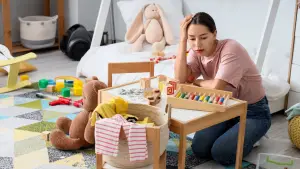
Your child walks in, drops her bag, and stops. She doesn’t answer when you ask about her day. She sits on the floor with her shoes still on and looks at nothing. You say her name twice and get nothing back.
An hour later she’s talking again like none of it happened, and you’re standing in the kitchen wondering whether you imagined it. If you’re at work at 3.30, you might be hearing this from your mum, or from the after-school staff, or seeing what’s left of it at six o’clock. You didn’t imagine it.
Shutting down means your child goes quiet, stops talking, stops moving much, and can’t answer you, even when she wants to. When your child shuts down when overwhelmed, it almost always happens after the hard part is over, which is exactly why nobody at school ever sees it.
The teacher is telling you the truth. So are you. Your child really did hold on for six hours, and she really did stop the moment she got home.
Most of what’s written about kids who are overwhelmed is written about the loud ones. The child who screams, throws, bolts, hits. That child gets noticed. That child gets referred.
Yours goes quiet. And quiet children wait a long time for anyone to ask.
Why your child shuts down when overwhelmed
When a child takes on more than her brain can process, her body protects her. Sometimes that protection looks like noise: crying, or bolting for the door. Sometimes it looks like stillness.
Going quiet is what a nervous system does when it has run past what it can handle. The body drops into a low-power state (hypoarousal). Speech is usually the first to go, then the ability to make a decision as small as which cup to use. It’s the same alarm system we’ve written about in emotional dysregulation, pointing in the opposite direction.
Autistic adults who live with this describe it better than the research does. They talk about the body turning suddenly heavy. Everything taking more effort than it should. Not being able to push through it, however much they want to.
There’s no diagnosis called this in children, and nothing about it in the diagnostic manuals. Autistic adults write about living with it. Parents describe it when they come in. It hasn’t been counted or measured properly yet, and we’d rather tell you that than pretend otherwise.
A school day is louder and brighter and more crowded than most adults would tolerate for six hours straight. The noise, the fluorescent lights, the uniform, the crowd at the school gate. Add the effort of looking calm when you aren’t, which has a name: masking. And for a lot of children in Western and South Western Sydney, add a full day of learning in a second or third language.
If your child melts down loudly instead, that’s the same event with the volume turned up, and we’ve written about the loud version separately. If you read that description and recognised yourself rather than your child, the adult version is here.
Parents tell us it looks like saving it up all day and handing it over at the door. Home is the only place safe enough to stop holding on.
When people tell you it’s your parenting
Every culture on earth has a version of the naughty child. None of them has a good word for the child whose nervous system quietly runs out of fuel at 2pm.
If you’ve been told you’re not strict enough, that he’s doing it on purpose, that in your family nobody behaved like this, you’re a long way from the first parent to hear it. Australian research is full of parents who heard the same thing, often from people who love them, and sometimes from people paid to help.
One Chinese Australian mother went to her son’s school to ask for support and was told by staff that she was a “typical Chinese mum”. She did the thing every parent is told to do, and the school heard her accent instead of her request.
Another mother in that study described what happened once other parents knew. “I can feel parents, once they know my son’s condition, they try to stay away from us, which is very heart-breaking.”
A study of Vietnamese Australian parents found the stigma fell hardest on mothers, and took its title straight from a parent’s mouth: We don’t make trouble. Cing, a Burmese refugee mother in Australia, described how her son was called “a naughty, spoiled child” for years before anyone recognised what was actually happening to him.
Quiet children carry a particular risk on top of all that. In a lot of families, including plenty of Anglo-Australian ones, a child who sits still and does what she’s told is exactly what a good child looks like. So she gets praised, and the question never gets asked.
Professor Valsamma Eapen at UNSW has described how easily this gets missed. Parents “may think of general shyness as a personality characteristic rather than specific differences or deficits in social skills.”
It costs time. In a study of 760 Australian children already in early intervention, families from culturally and linguistically diverse backgrounds first became worried about their child nearly three months later than other families. Three months adds to everything else that’s already slow.
So when your family tells you you’re spoiling him, they’re describing what they can see from where they’re standing. They’ve never been there at 3.30. And if you’ve been told to be stricter, here’s why consequences don’t work the way people expect.
What helps, starting tonight
Try these, roughly in this order.
Guard the first hour. When she comes in, ask nothing. Food, and quiet. She’s been holding on since nine in the morning and there’s nothing left; more demands at 3.30 push her further down instead of pulling her out. Homework can wait an hour. If you’re not the one there at 3.30, tell whoever is.
Take input away instead of adding it. Turn a light off. Turn the TV off. Fewer people talking at her, if that’s possible in your house. When a brain is conserving, extra input makes the state last longer.
You don’t need a spare room for this. In a two-bedroom flat with three kids there isn’t one, and that’s fine. Lowering the input works in whatever room you’re in.
Stop asking questions while it’s happening. Words are usually the first thing to go, so questions arrive as more work at the worst possible moment. Sit near her. Offer something she can answer by pointing or nodding. Talk to her later.
Give it a name afterwards. When she’s back, keep it simple. “Your body got too full and went quiet. That’s okay.” Children can’t ask for help with something they have no words for, and this is how the words get built. Do it after, never during.
Watch the mornings. If getting out the door starts getting harder, take that seriously early rather than late. We’ve written about school refusal, which often starts here.
Two reasons to see a GP
The first is food. Most fussy eating isn’t a medical problem. But book a GP appointment if the list of things your child will eat keeps shrinking, if she’s losing weight or not growing, if a whole food group has disappeared, or if mealtimes are getting worse rather than better.
Sensory-driven food avoidance is one of the drivers of a real eating disorder called ARFID. In children seen by paediatricians, the commonest picture is a mix of sensory sensitivity and low appetite. Letting a child eat only the foods she feels safe with is kind advice, and it can quietly let her slide into deficiency.
The second is hearing. A child who doesn’t respond might not be hearing or processing sound properly. Ask your GP for a hearing check, and ask what it will cost before you go. There are free and low-cost options for children, and your GP can tell you which ones your family can use. A test tells you for certain that hearing isn’t the problem, before you assume your child is choosing to ignore you.
OT, psychologist or GP: who to see first, and what’s free
Parents get told to see an occupational therapist, or a psychologist, or both. You rarely get told which comes first.
Your GP is where a referral starts, either way. For a child whose main difficulty is sensory, the occupational therapist is usually the one who does that assessment and works on the daily-life side of it: the uniform, the classroom, the bus, the hour after school.
A psychologist is the right call when there’s anxiety sitting alongside it, low mood, not speaking at school, or something frightening in your child’s history. That combination is more common than parents expect with this child. Holding yourself together for six hours a day, every day, is a good way to end up frightened of school itself. A psychologist works on the fear and the avoidance, and on your child’s own understanding of what’s happening in her body.
If the real question is whether this is autism or ADHD, start with your GP or a paediatrician. We’ve written separately about what a good assessment looks like.
Before any of that costs you anything, there’s the school.
In NSW public schools, a child does not need a formal diagnosis to get support. Department policy says the school can act on what your child needs with nothing on file. Ask for a meeting with the learning and support team, which usually includes the school counsellor and a learning and support teacher. No waitlist, and no cost. You can email the school on Monday morning.
If English isn’t the language you’d choose for a meeting like that, you can ask the school to arrange an interpreter. You can also do it yourself. Call TIS National on 131 450, ask for your language, and the operator will ring the school and interpret for you. It’s free, and you don’t have to explain why you want one.
The public system beyond the school gate is slower, and you deserve the real number before you build your plans around it. At South Western Sydney’s child development assessment service, half the families waited more than 302 days, about ten months. Most of those children were preschoolers, and the school-age ones in that study waited less.
You’ll also be offered sensory integration therapy, sensory diets, brushing programs and weighted blankets. The evidence behind them is thinner than the marketing suggests. The Raising Children Network (government funded, with nothing to sell you) says some studies show sensory integration therapy doesn’t help autistic children, and that the studies suggesting it might have problems with how they were designed. A trial of weighted blankets with 67 autistic children aged 5 to 16, all of whom had severe sleep problems, found they slept no longer and woke just as often, although the children and their parents liked them.
Keep seeing your OT if it’s helping. You’re entitled to know what the research actually says before you spend your own money, or your child’s NDIS funding, on any of it.
What changes
The hour after school stops being a fight, mostly because you stop fighting it.
Your child starts telling you she’s full before she stops talking, because somebody finally gave her the words for it.
You stop apologising to teachers for a child who seems fine.
And when you do go into the school, you go in with something specific to ask for instead of a feeling you can’t quite explain. One mother we worked with brought an interpreter to that meeting and read out three sentences she’d written down beforehand. She came out with an adjustment in place that had never been offered before.
Another parent told us her son still shuts down. What changed is that she knows what she’s looking at now, and the hour stopped frightening her.
The report might still say quiet. You’ll know what it means.
Where to start
Tonight, try one thing. When she comes through the door, say nothing at all, and put food in front of her. See what the hour looks like.
If you want someone to look at this properly with you, there are a few ways to do it.
Star4Kids is free psychological support for children aged 3 to 12 across South Western Sydney, for families who find it hard to afford Medicare sessions. There are eligibility rules, and one phone call will tell you whether your family fits. It costs nothing to find out.
If your child has an NDIS plan with therapeutic supports, we can help, and we’ll handle the paperwork.
If you’ve got a Mental Health Treatment Plan from your GP, Medicare pays back part of the cost of each session with us, and we’ll tell you the gap before you book.
And if you’re exhausted yourself, that’s worth saying out loud too. Parent burnout is its own problem, and it’s common in families doing this.
References
Harvard style, accessed 26 August 2026.
- Autism Spectrum Australia (Aspect) n.d., A refugee finds support for her autistic son. https://www.aspect.org.au/blog/refugee-finds-support-for-autistic-son
- Bentley, S.E., Garg, P., Gudes, O., Hurwitz, R., Vivekanandarajah, S. & So, L.Y.L. 2024, ‘Access to child developmental assessment services in culturally and linguistically diverse metropolitan Sydney: a retrospective cohort analysis’, BMC Health Services Research, vol. 24, 342. https://link.springer.com/article/10.1186/s12913-024-10800-y
- Chamas, Z. 2024, ‘Why women of colour are being left behind due to delays in autism diagnosis’, ABC News, 28 April. https://www.abc.net.au/news/2024-04-28/autism-in-cald-communities-diagnosis-delay-in-women/103730058
- Gringras, P. et al. 2014, ‘Weighted blankets and sleep in autistic children: a randomized controlled trial’, Pediatrics, vol. 134, no. 2, pp. 298-306. https://pubmed.ncbi.nlm.nih.gov/25022743/
- Guy’s and St Thomas’ NHS Foundation Trust n.d., Heavy blankets do not help children with autism sleep. https://www.guysandstthomas.nhs.uk/news/heavy-blankets-do-not-help-children-autism-sleep (Plain-English summary of the Gringras trial, linked in the article because the journal article is paywalled.)
- Hussain, A., John, J.R., Dissanayake, C., Frost, G., Girdler, S., Karlov, L., Masi, A., Alach, T. & Eapen, V. 2023, ‘Sociocultural factors associated with detection of autism among culturally and linguistically diverse communities in Australia’, BMC Pediatrics, vol. 23, 415. https://link.springer.com/article/10.1186/s12887-023-04236-2
- NSW Department of Education 2025, Inclusive education for students with disability (PD-2005-0243). https://education.nsw.gov.au/policy-library/policies/pd-2005-0243
- Raising Children Network n.d., Sensory integration therapy and autism. https://raisingchildren.net.au/autism/therapies-guide/sensory-integration
- Smith, J. et al. 2023, ‘”They were saying that I was a typical Chinese mum”: Chinese parents’ experiences of parent-teacher partnerships for their autistic children’, Journal of Autism and Developmental Disorders, vol. 53, no. 12, pp. 4888-4900. https://pmc.ncbi.nlm.nih.gov/articles/PMC9510549/
- Smith, J. et al. 2023, ‘”We don’t make trouble”: Vietnamese parents’ experiences of parent-teacher partnerships for their autistic children’, Research in Autism Spectrum Disorders, vol. 103, 102142. https://discovery.ucl.ac.uk/id/eprint/10168789/
- Touyz, S., Rabbering, T., Crino, N. & Maguire, S. 2023, ‘Avoidant/restrictive food intake disorder: an undetected and overlooked eating disorder?’, Medicine Today, vol. 24, no. 10, pp. 29-33. https://medicinetoday.com.au/mt/2023/october/feature-article/avoidant-restrictive-food-intake-disorder-undetected-and-overlooked-eating-disorder